Urban Air Mobility & Drone Logistics: New Skills Demand.
Advanced ManufacturingAerospace InnovationDrone LogisticsUrban Air Mobilityfuture skills
The report provides an in-depth analysis of the emerging demands for skills in the Urban Air Mobility (UAM) and drone logistics sectors. It examines market growth projections, technological advancements, regulatory landscapes, and workforce needs across North America, Europe, and Asia-Pacific. The document stresses the urgency of addressing skills gaps in areas such as AI systems, UTM operations, and eVTOL maintenance to support the sector's expansion. By highlighting strategic workforce development and cross-industry collaboration, the report aims to guide stakeholders in aligning educational frameworks with industry demands.
Vivek Goswami, Ghost Research
December 2025
Perspective.
PurposeTo address the emerging skills demands in Urban Air Mobility and drone logistics.
AudienceIndustry professionals, policymakers, and educators.
Special EmphasisInnovation, regulatory compliance, sustainability.

56Pages of Deep Analysis
98Curated Credible Sources
2Proprietary AI Visuals
4Data Analysis Tables
$495

Vivek Goswami
11+ Years of Experience
Sectors & Industries
IndustrialsConsumer StaplesEnergy
Functions & Expertise
Market IntelligenceStrategy & GTM
Have questions? Our Research Desk is here to help
Top Insights.
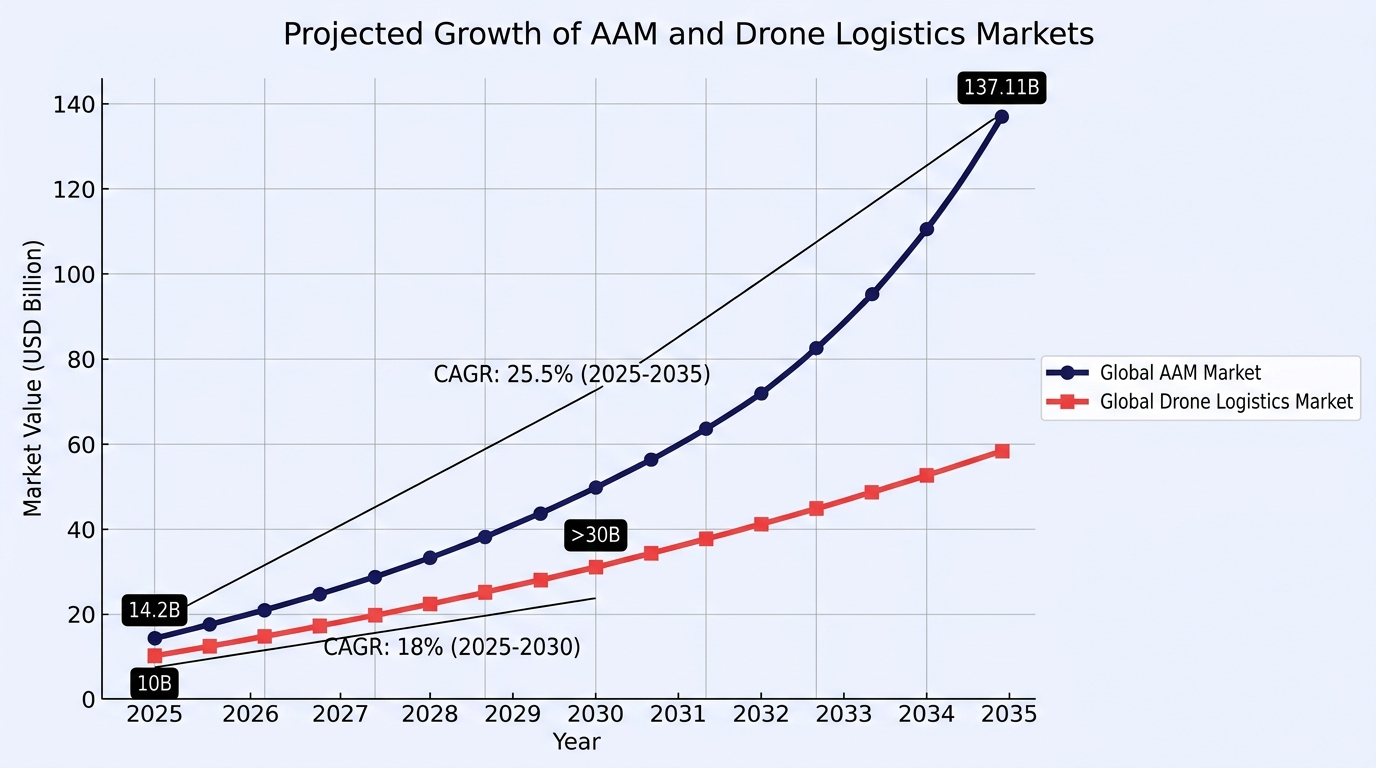
The AAM and drone logistics sector is projected to grow at a CAGR of over 20%, reaching between $77.5 billion and $137 billion by 2035.Key skills gaps exist in AI systems, UTM operations, and eVTOL maintenance, threatening scalability.Education initiatives are evolving with new academic and vocational programs to meet these demands.Public-private partnerships are crucial for skill development, evidenced by FAA initiatives and corporate training programs.Regionally, disparities in skill availability could slow global market expansion.Key Questions Answered.
56Pages of Deep Analysis
2Proprietary AI Visuals
98Curated Credible Sources
4Data Analysis Tables
Summary.