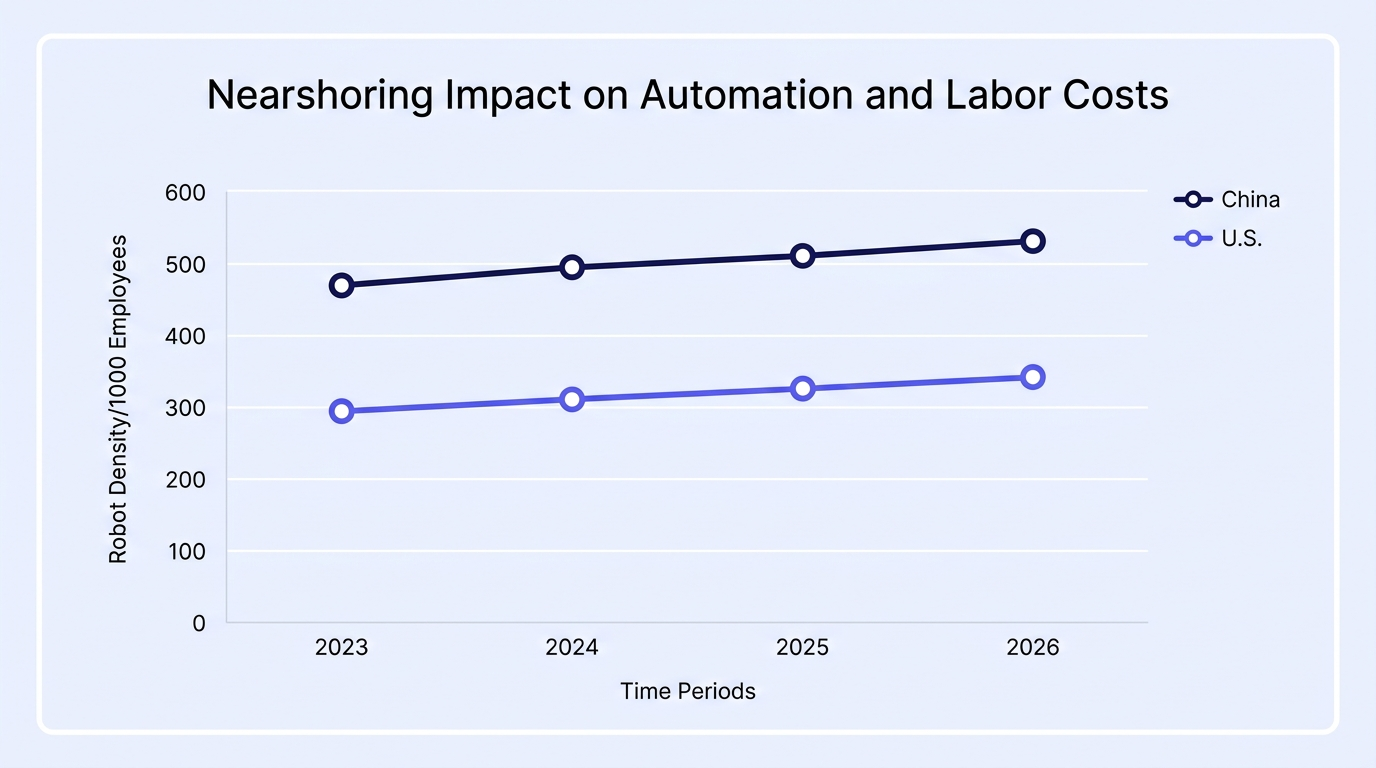
Industrial Supply Chain Resilience: Nearshoring Economics vs Cost Inflation.
AI AutomationCost InflationGeopolitical RiskIndustrial StrategyNearshoringOperational EfficiencySupply Chain Resilience
This report examines the balance between nearshoring as a strategy to enhance supply chain resilience and the resulting economic impacts, specifically cost inflation. It highlights how geopolitical factors, policy changes, and technology advancements are reshaping supply chain dynamics. The document emphasizes the strategic use of automation and AI in mitigating cost pressures associated with nearshoring. Insights include regional and industry-specific analyses to guide strategic decisions for industrial leaders.
Abhishek Singh, Ghost Research
February 2026
Perspective.
PurposeTo analyze nearshoring as a strategy for enhancing supply chain resilience and its economic implications.
AudienceIndustrial and technology supply chain leaders seeking strategic guidance.
Special EmphasisEmphasizes sustainability, policy compliance, and the role of AI and automation.

138Pages of Deep Analysis
120Curated Credible Sources
32Proprietary AI Visuals
31Data Analysis Tables
$495

Abhishek Singh
3+ Years of Experience
Sectors & Industries
IndustrialsInformation Technology
Functions & Expertise
OperationsMarket Intelligence
Have questions? Our Research Desk is here to help
Top Insights.
Nearshoring enhances resilience by reducing transit times and exposure to geopolitical risks.The use of AI and automation is crucial in offsetting the cost inflation from nearshoring.Regional strategies must account for labor costs, logistics reliability, and compliance requirements.Sector-specific strategies have emerged, particularly in semiconductors and automotive industries.Future supply chains will likely be hybrid systems combining nearshoring and global sourcing.Key Questions Answered.
138Pages of Deep Analysis
32Proprietary AI Visuals
120Curated Credible Sources
31Data Analysis Tables
Summary.