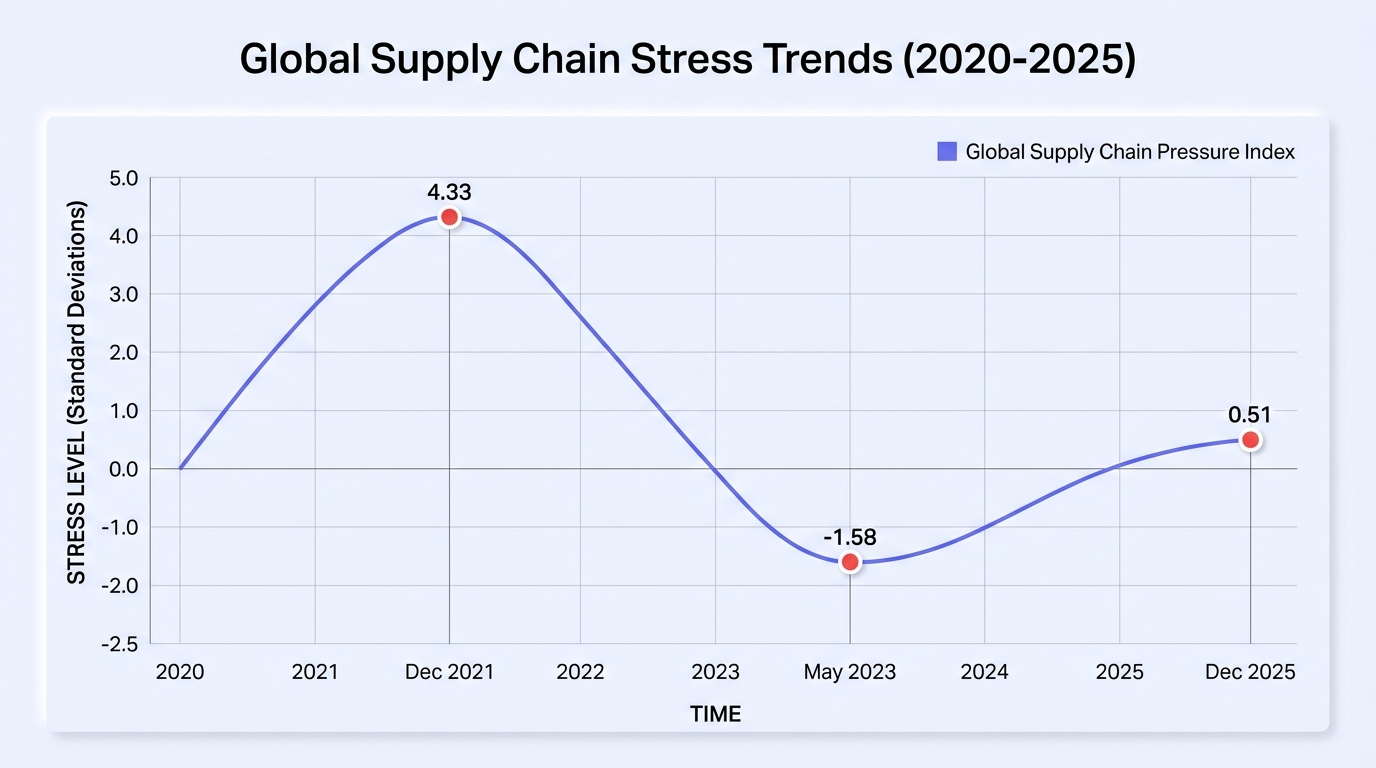
Supply Chain Stress Index for Global Industrials.
Future LogisticsGovernment Risk ToolsSupply Chain StressTrade Data Analytics
The report provides an in-depth analysis of stress and resilience within global industrial supply chains. It develops the Supply Chain Stress Index (SCSI) to monitor, measure, and project stress levels. The study incorporates data on trade flows, logistics, news signals, and AI-driven metrics to understand vulnerabilities and resilience. Scenario analysis from 2020 to 2025 aids in anticipating future disruptions and policy implications. The report is aimed at enhancing decision-making for stakeholders in industrial policy and infrastructure planning.
Asmita Bhange, Ghost Research
February 2026
Perspective.
PurposeTo systematically measure and monitor supply chain stress in global industrial sectors.
AudiencePolicymakers, industry leaders, supply chain managers, and economists.
Special EmphasisResilience, policy strategy, and technological adoption.

176Pages of Deep Analysis
157Curated Credible Sources
20Proprietary AI Visuals
36Data Analysis Tables
$495

Asmita Bhange
6+ Years of Experience
Sectors & Industries
IndustrialsInformation Technology
Functions & Expertise
Market IntelligenceData & AI
Have questions? Our Research Desk is here to help
Top Insights.
The SCSI serves as a macroeconomic variable akin to inflation.AI-driven metrics offer early warning capabilities for supply chain disruptions.Regional vulnerabilities highlight the significance of Africa and Southeast Asia.The geopolitical climate heavily influences supply chain stress patterns.Cross-border coordination can mitigate stress amplification.Key Questions Answered.
176Pages of Deep Analysis
20Proprietary AI Visuals
157Curated Credible Sources
36Data Analysis Tables
Summary.