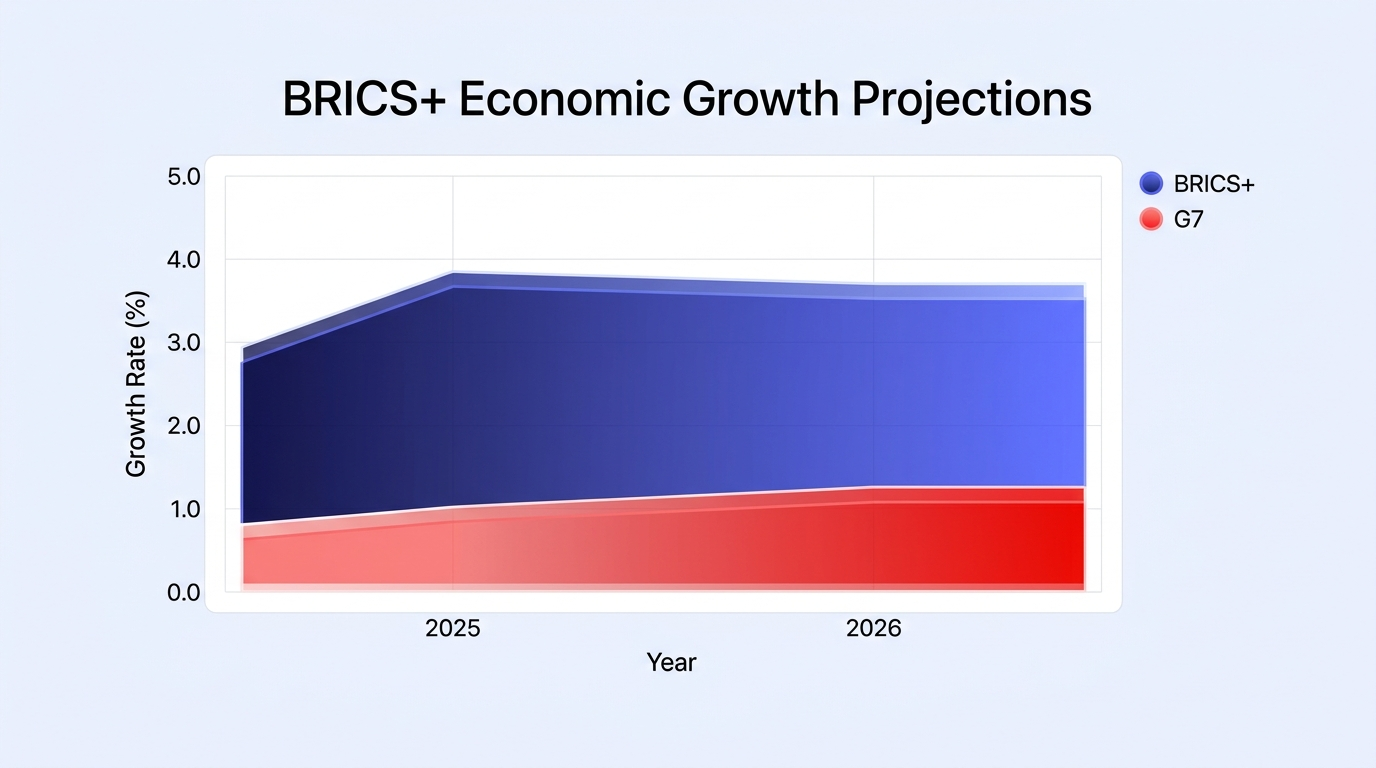
BRICS Expansion 2026: Reshaping Trade & Investment.
BRICSBRICS expansionGeopolitical Strategytrade investment
The report provides an in-depth analysis of the BRICS expansion in 2026, focusing on trade and investment impacts. It discusses the inclusion of new members like Egypt, Ethiopia, Iran, the UAE, and Indonesia, and how this integration enhances economic performance and financial sovereignty. The report highlights the strategic shift away from Western-centric governance towards a more multipolar global order. Additionally, it examines the risks, opportunities, and strategies for stakeholders in navigating this new economic landscape.
Balemlay Addis, Ghost Research
January 2026
Perspective.
PurposeTo analyze the impact of the BRICS expansion on global trade and investment.
AudiencePolicymakers, institutional investors, and corporate strategists.
Special EmphasisMultipolar governance, economic integration, de-dollarization.

44Pages of Deep Analysis
82Curated Credible Sources
2Proprietary AI Visuals
6Data Analysis Tables
$495

Balemlay Addis
6+ Years of Experience
Sectors & Industries
Financials
Functions & Expertise
Finance & Investment
Have questions? Our Research Desk is here to help
Top Insights.
BRICS+ is expanding to include key economies from Africa, Asia, and the Middle East, strengthening global South cooperation.Intra-BRICS+ trade is predicted to reach $2.5 trillion by 2024, propelled by infrastructural developments and local currency initiatives.BRICS+ challenges Western financial systems through de-dollarization and local currency trade.BRICS+ enhances geopolitical influence by boosting IMF voting shares and promoting multilateral institution reform.Strategic risks include geopolitical tensions, economic vulnerabilities, and policy coordination challenges.Key Questions Answered.
44Pages of Deep Analysis
2Proprietary AI Visuals
82Curated Credible Sources
6Data Analysis Tables
Summary.